Susan Bookman is a teacher, ceremonial leader, and visionary architect whose work bridges shamanism, spiritual inquiry, mental alchemy, and transpersonal communication. A writer and artist as well, she has lived in the Sacred Valley of Peru since 2005, where she continues to develop her original frameworks for ritual, healing, and personal transformation.
Her own healing path began in 1982 through a series of intense, recurring episodes of sleep paralysis, which later culminated in powerful, involuntary kundalini awakenings. Over the years that followed, her empathic and intuitive abilities deepened, revealing a natural capacity for healing and subtle perception. These initiatory experiences laid the foundation for a life devoted to the study of consciousness, energy, and the unseen architecture of human transformation.
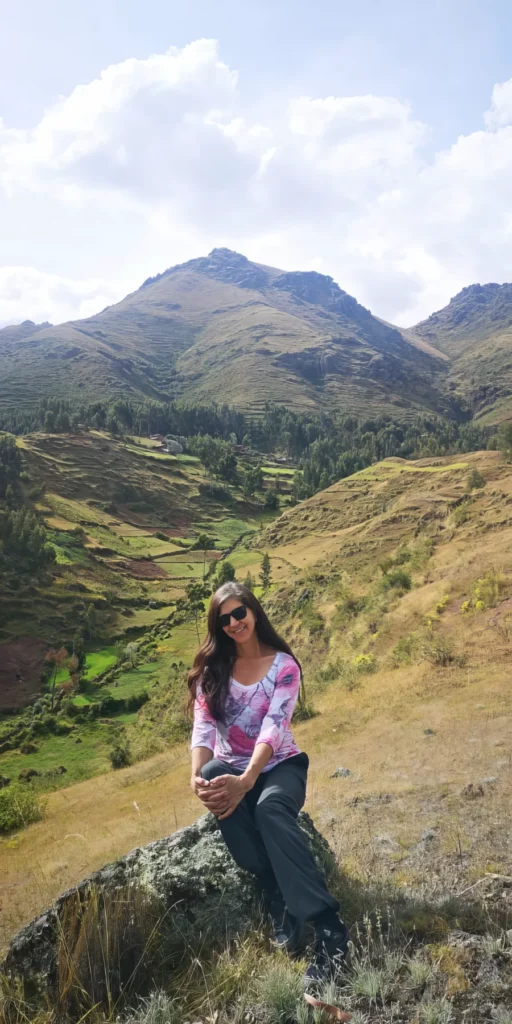
Through decades of inner work, ceremonial practice, and spiritual discipline, Susan cultivated a unique body of teachings and techniques she refers to as Technologies of Mind, Heart, Body, and Breath. This approach blends authenticity, discernment, and self-mastery, supporting individuals in awakening their capacity to embody and radiate love, light, and truth. At its heart, her work is about converting challenge into power, and complexity into coherence.
Susan’s work is not derived from any single tradition or methodology, but from a lifetime of deep listening, refined observation, and direct communion with the visionary realms. Her teachings often explore the threshold where language becomes light, where breath becomes a bridge, and where the unseen becomes speakable.
In addition to her decades of experience in alternative healing and ritual arts, she holds an MA in International Communications and Development from the American University School of International Service in Washington, DC, and has extensive experience in international business and sustainable development. She has lived, studied, and worked throughout Europe, Asia, Africa, and South America. She speaks Spanish fluently, French competently, and Quechua recreationally.